Mingus Imperium
The Robot Who Looked Like MeThe Mingus Imperium is a world-spanning autocracy built by Emperor Mingus in a future Earth divided by disorder. Its reach rests on two forms of control: an extensive surveillance apparatus and the Emperor’s ability to alter events through time travel. Yet the same time machine that makes his authority seem nearly absolute contributes to a crisis that the Empire cannot contain. Its history turns on a stark contradiction: Mingus claims to have imposed order for the sake of civilization, while the means of maintaining that order help make the system progressively less governable.
Origins and Imperial Justification
Mingus describes a future Earth depleted in both physical and mental resources, divided into small, quarrelsome kingdoms and governed by force rather than peace. He says he entered that future after inventing a time machine, took power in conditions favorable to centralized organization, and believed himself suited to the task. In his account, the Empire provides security and continuity from which civilization might be rebuilt.
His stated ambition extends beyond order. Mingus says he intends peace and prosperity for everyone, with political freedom to follow once people have acquired the intelligence and self-control to use it. He treats democracy not as a natural condition but as a difficult practice requiring education, responsibility, and fairness. His defense of imperial rule thus casts political freedom as a future reward, while granting the Emperor authority to decide when the population is ready for it.
Mingus presents his choice as preferable to either abandoning the future or establishing a fragile democracy that would collapse once its founders lost physical control. He claims to have formed the political organization that the people of that era could understand, then to have tried to educate them toward greater freedom. This is his justification, not an independent account of how the Empire governs: the same ruler who promises eventual liberty maintains a police state and reserves decisive power to himself.
Surveillance and Rule
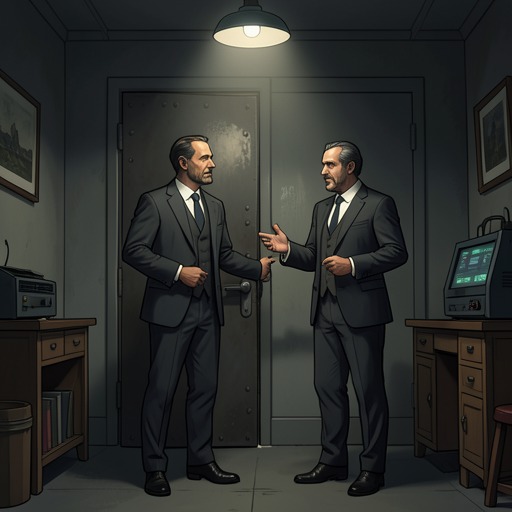
In Mingusville, government is described as the most consequential public activity, and Mingus as the one man who rules the world. The Empire’s ordinary surveillance is extensive: cameras and recorders are placed throughout society, miles of film and tape are accumulated, and legions of personnel monitor the recordings. Other people monitor the monitors, creating successive layers of observation that ultimately lead to Mingus, the system’s final authority.
This apparatus makes imperial oversight a chain with a single endpoint. Monitoring does not stop at the people being watched; it extends to the watchers themselves, while the Emperor remains above the chain as its ultimate monitor. The arrangement gives the state an elaborate capacity to collect and review information, but its concentration of final judgment in Mingus also makes the Empire’s security dependent on one ruler.
The material setting reported in Mingusville contrasts with this ambition to control the world. Individual telephones are limited to officials, electricity is scarce and expensive, and equipment maintenance is haphazard. Many homes rely on kerosene lighting, while the town’s open-air market faces a large police barracks. These details locate imperial authority not in uniformly advanced infrastructure but in a society where basic services and upkeep are uneven, even as surveillance and policing remain defining features of rule.
The Time Machine and Resistance
The Empire’s most exceptional instrument is Mingus’s time machine, described by local people as a white-plastic object roughly the size of a shoe box. When something goes wrong, Mingus can travel back and try to correct it, subject to natural restrictions. The machine can also be used against opponents before they become active: rather than searching for underground leaders in the present, the Emperor can go back to an earlier point in their lives. Time travel gives imperial repression a reach beyond ordinary policing, including the possibility of acting before a threat has fully emerged.
That reach has a crucial physical limit. Mingus must operate the machine himself and cannot entrust it to anyone else, because an operator could travel back and kill him, taking the throne. The restriction leaves the time machine as a personal instrument of sovereignty rather than a delegated state resource. It helps explain why the Empire’s immense surveillance network remains necessary: Mingus can act directly against some enemies through time, but his power cannot eliminate every opponent or replace the work of finding and suppressing those beyond his individual reach.
A resistance movement survives for precisely this reason. Some opponents cannot be located and destroyed by the time machine; those vulnerable to such intervention have already been removed, leaving the Imperial organization to pursue the enemies Mingus cannot personally reach. But Mingus’s efforts to contain the resistance also deepen the conflict. He says he tried to kidnap some of the Gleisters opposing him and re-educate them, then returned to their organization and infiltrated it. By the time he addresses them, he claims to have taken it over. The resistance is therefore both an armed political danger to the Empire and an organization the Emperor seeks to absorb or control.
Imperial Crisis and Significance
In the late years of the Mingus Imperium, the Emperor’s assessment changes from confidence to disaster. At the White House, now described as a Byzantine city within a city, an aged Mingus appears with gray hair and ravaged eyes. He acknowledges that the Empire is failing. His explanation is not simply a loss of political control: each use of a time machine leaves a displacement that nature fills by producing another Gleister. Those duplicates travel through time in turn, creating further displacements and further duplicates.
Mingus recognizes the result as geometric growth. He has managed to house about twelve million Gleisters, but the Empire is running out of resources as new arrivals come at an accelerating rate. Even shooting them on sight would not stop the progression. In his bleak projection, Earth will eventually be covered by Gleisters, with more continuing to arrive. The state’s military and administrative power cannot solve a crisis produced by the expanding consequences of time travel itself.
The Empire’s arc therefore reverses its founding promise. Mingus used the machine to intervene in a fractured future and establish continuity, but every journey through time participates in a multiplying process that his rule cannot command. The Emperor’s celebrated corrective power becomes a source of systemic instability; the ruler who can reach backward to prevent individual threats cannot halt the aggregate consequences of those interventions. The Mingus Imperium is at once a police state, a political project defended as preparation for future freedom, and a failing regime trapped by the temporal mechanism on which its supremacy depends.